
Why Ant Trails Keep Appearing Around Holmdel Kitchens

Written by Jack Hayes
Last updated on September 14, 2026
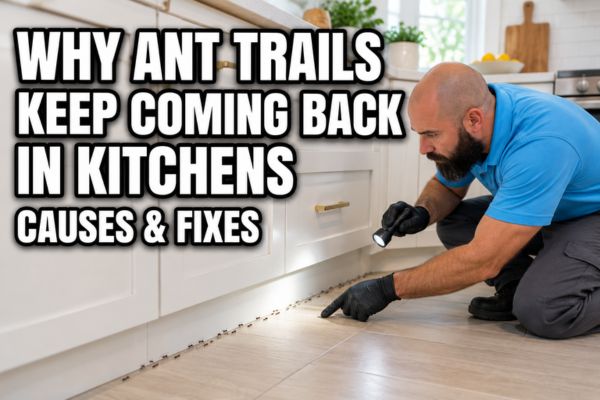
Ant trails keep returning to kitchen counters, sinks, and cabinet edges because the visible ants are only part of the problem. Once a foraging ant finds food or water, it can lay a chemical trail that guides nestmates back to the same resource. Cleaning may interrupt that route, but new workers can rebuild it if the colony, attractant, or entry point is still active. For Holmdel homeowners, the useful question is not just “How do I wipe away the trail?” but “What is keeping this route worth using?”
Key Takeaways
◉ Ant trails form when foraging ants find food or water and recruit other workers along a chemical route.
◉ Cleaning the surface can disrupt a trail, but it does not eliminate a colony that is still sending workers indoors.
◉ A returning trail can help you trace the likely entry point, food source, moisture source, or nesting area.
◉ Ant species matter because nesting habits, food preferences, and suitable control methods differ.
◉ Repeated trails, multiple rooms, or large ants near damp wood are good reasons to get the pest identified before choosing treatment.
Why Ant Trails Reappear After You Clean Them
Ants commonly travel between a nest and a food or water source by following pheromone trails. A worker that finds something useful can recruit nestmates, and successful foragers reinforce the route as they move back and forth. University of Minnesota Extension explains that ants often use regular chemical trails and that killing foraging workers has little effect on the colony by itself.
That is why wiping a counter can make the line disappear without ending the problem. If crumbs, grease, pet food, condensation, a leaking pipe, or another resource remains available, new ants can search the area and establish the route again.
What a Returning Trail Can Tell You
Before cleaning the next trail, watch it for a few minutes. A visible line can give useful clues about where ants are entering and what they are finding.
◉ Follow the trail in both directions and note where ants disappear into a wall gap, baseboard seam, window frame, cabinet joint, or plumbing opening.
◉ Check the destination for crumbs, grease, sugary residue, pet food, trash, recycling residue, or moisture.
◉ Notice whether the ants are tiny and uniform or noticeably larger. Size can narrow the possibilities but does not confirm a species.
◉ Take a clear photo before cleaning if identification may be needed later.
If trails continue after basic sanitation and exclusion, Agile Pest Control’s Holmdel pest control services page is the appropriate local next step for homeowners who want the source inspected rather than guessing from the trail alone.

Which Ant Could Be Making the Trail?
A trail by itself does not identify the ant. Small brown or dark ants found in kitchens can include odorous house ants, pavement ants, and other household species. Odorous house ants are small and may produce a distinctive odor when crushed, while pavement ants often nest under sidewalks, slabs, stones, or similar protected sites. Both can forage indoors for food.
Carpenter ants deserve separate attention because they are generally larger and nest in wood rather than eating it. Rutgers NJAES notes that carpenter ants often use moist or partially decayed wood for nesting and may forage indoors. In the Northeast, they are typically active from May through October, with peak activity in July. Large ants near damp wood can justify closer inspection, but one ant sighting does not prove hidden structural damage.
Correct identification matters because food preferences, nest locations, and management options vary by species.
Why Cleaning Alone Is Usually Temporary
Cleaning is still useful. Removing food residue reduces what ants are finding, and wiping the travel path can disrupt the chemical trail. The limitation is that sanitation works on the kitchen conditions, not necessarily on the colony.
If workers are entering from outdoors or a hidden nesting area, they can keep exploring after the original trail is removed. The route may reappear in the same place or shift nearby. This is also why repeatedly killing only visible workers can make the problem seem solved while the source remains active.
Agile Pest Control’s article on whether killing ants attracts more ants explains why visible activity and colony control are not the same thing.
Kitchen Conditions That Keep the Route Active
Even a clean kitchen can provide enough food or moisture for foraging ants. Focus on small resources that are easy to miss.
◉ Store pantry foods, sweets, and pet food in tightly closed containers.
◉ Wipe grease and food residue from counter edges, stovetops, cabinet handles, and beneath small appliances.
◉ Clean recycling containers and avoid leaving food residue in trash overnight.
◉ Repair dripping faucets or leaking plumbing and dry persistent moisture under sinks.
◉ Check gaps around windows, doors, utility lines, plumbing penetrations, and baseboards that ants are actively using.
These steps reduce the reason for ants to keep using the kitchen, but they may not eliminate a nest already established nearby.
What to Do When the Trail Keeps Coming Back
Start with observation, sanitation, and moisture correction before adding more products. If you can trace an entry gap, note it before sealing so you do not lose the clue to where ants are coming from. Once the activity is understood, accessible gaps can be sealed to reduce future entry.
Baits can be useful for some ant problems because workers carry food back toward the colony, but bait choice and placement depend on species and feeding preference. Always follow the product label. Avoid spraying insecticide on or around a bait station because it can interfere with ants feeding on the bait.
For more detail on how baiting works, see Agile Pest Control’s guide to ant bait traps rather than treating this article as a full baiting manual.
When to Call a Professional
Professional identification becomes more useful when trails return after consistent cleaning and moisture control, when ants appear in several rooms, or when the trail disappears into a wall or inaccessible void.
It is also sensible to get help when the ants are large, repeatedly appear near damp wood, or are accompanied by wood shavings or other signs that could point to a carpenter ant nest. Those clues are not proof of structural damage, but they are worth investigating before choosing a treatment.
A good inspection should focus on species identification, travel routes, food and moisture sources, entry points, and likely nesting areas. That keeps the response tied to the ant’s biology instead of relying on a one-size-fits-all spray.
Frequently Asked Questions
Why do ants come back to the exact same spot after I wipe the counter?
The colony may still be active and sending workers to a reliable food, water, or entry point. Cleaning can disrupt the trail, but new foragers can re-establish a route if the conditions that attracted them remain.
Does vinegar permanently remove an ant trail?
No. Vinegar or another household cleaner may temporarily disrupt trail-following behavior, but it does not eliminate the colony. Lasting improvement usually depends on removing food and moisture, addressing entry points, and using species-appropriate control when needed.
Does a kitchen ant trail mean the nest is inside the wall?
Not necessarily. Many ants nest outdoors and travel inside to forage. A trail disappearing into a wall gap may be an entry route rather than the nest itself. Repeated activity from the same interior opening can justify closer inspection.
Share