
Does Killing Ants Attract More Ants?

Written by Jack Hayes
Last updated on June 20, 2026
On this page
You see an ant on the counter. You kill it.
Then more ants show up in the exact same spot.
That’s when the question hits: Does killing ants attract more ants?
The answer is: sometimes, yes.
Not because ants “call for backup,” but because of pheromones. Ants rely on scent trails to move between food and their colony. When you kill an ant, those trails stay active, and in some cases, crushed ants can release signals that make the area more noticeable.
So instead of stopping the problem, you may accidentally attract more ants to the same spot.
The good news? Once you understand how pheromones work, this becomes much easier to fix. This guide will help you to do it.
Key Takeaways
◉ Killing ants can sometimes lead to more ants because scent trails stay active
◉ Indoor spaces make ant problems worse due to stable surfaces, food, and moisture
◉ The real issue isn’t killing ants-it’s not removing trails and entry points
◉ Effective ant control disrupts the colony’s routine, not just visible ants
◉ Repeated ant activity often points to hidden nests or structural gaps
Why Killing Ants Attracts More Ants?
Killing ants doesn’t directly attract more ants—but what’s left behind often does.
1. Ant Colonies Adjust, They Don’t Panic
Ants work as a system, not individuals. When one ant disappears, the colony doesn’t panic—it sends more scouts.
If the area still has food or an active scent trail, the colony keeps using it. Indoors, this happens quickly because distances are short and conditions stay stable.
So killing ants doesn’t stop traffic—it often triggers more checking.

2. Scent Trails Stay Active After the Ant Is Gone
Ants follow invisible chemical paths called pheromone trails.
When you kill an ant, the trail doesn’t disappear. The surface still signals: “This path leads to food.”
That’s why ants keep returning to the exact same spot—even after you’ve cleaned visible ants. You removed the insect, but not the trail guiding others back.
3. Indoor Spaces Amplify the Problem
Outside, rain and weather naturally break down scent trails.
Inside your home, those trails last longer, which means ants can reuse them again and again.
Stable surfaces, steady food sources, and controlled conditions create an environment where ants keep returning unless you actively disrupt the trail and access points.
A Real Homeowner Experience on It
This is a situation we hear about all the time.
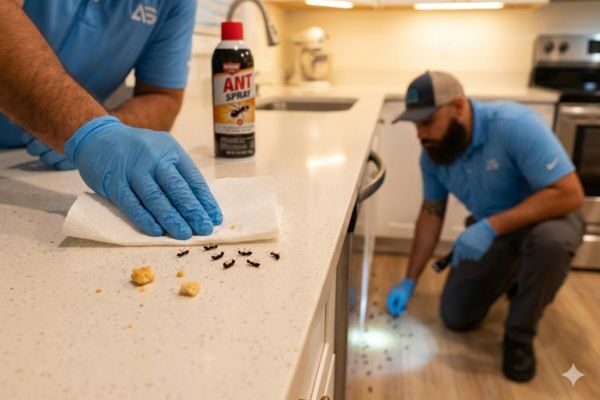
A homeowner noticed a few ants on the kitchen counter and kept killing them as they appeared. The counter was wiped down. Everything looked fine. Problem solved… or so it seemed.
Later that day, a few more ants showed up in the exact same place.
The next morning, it happened again. Same spot. Same line of ants.
When we inspected the home, there wasn’t any new food on the counter. No fresh spills. Nothing obvious that explained why ants kept choosing that one area. But from the ants’ point of view, the route still made sense.
The scent trail they were following was still active.
Killing the ants removed the insects, but it didn’t remove the signals they left behind. As long as that trail stayed active, the colony kept sending new ants to check the path. Indoors, where surfaces don’t change much, that process repeats quickly.
That’s why the problem felt never-ending. Each ant that didn’t return triggered another scout. And because nothing about the surface or access point changed, the ants kept coming back to the same exact spot.
In another case, a homeowner in Little Silver was dealing with a carpenter ant issue that kept returning even after previous treatments. After a full inspection, the root cause became clear—active trails and hidden entry points were never fully addressed.
Once the trail was properly removed and access points were sealed, the activity finally stopped.
This is why killing ants alone rarely solves the problem. You’re removing individuals, not changing the route or the reason ants are there. Until the trail is broken and the entry point is fixed, ants will keep treating that area as usable and return.

Common Mistakes That Accidentally Invite More Ants
Killing Ants Without Removing the Trail
Killing ants feels productive, but on its own, it doesn’t solve anything.
Ants don’t follow bodies. They follow chemical cues.
If those cues stay in place, the colony keeps sending ants to the same area.
That’s why people end up killing ants in the same spot over and over.
Leaving Food, Moisture, or Crumbs Behind
Ants don’t wander randomly. They move toward payoff.
Crumbs, spills, pet food, trash liners, and even damp areas all count as high-value targets. From the colony’s perspective, a short and safe path to food is worth repeating.
As long as the resource stays, traffic continues.
Blocking One Path but Ignoring Others
Stopping ants in one spot can feel like progress, but ants don’t rely on a single entrance.
If one route fails, they test others. Tiny cracks, door gaps, pipes, and window edges all become backups.
Focusing only on where ants appear instead of how they’re getting in keeps the cycle going.
Delaying Treatment Leads to More Problems
A homeowner noticed a large wasp nest in their tree, along with growing ant activity inside. After reaching out, both issues were addressed quickly and professionally, giving them confidence that the problem was fully resolved.

How To Stop Attracting More Ants After Killing Them
Break the Scent Trails Completely
This goes beyond basic cleaning. You’re trying to erase the trail completely.
Wipe down the exact paths ants were using, especially along edges and corners. Use soapy water or a vinegar mix to break the pheromone trails they rely on.
When those signals are gone, the colony pauses instead of sending reinforcements.
Use Methods That Disrupt the Colony, Not Just Scouts
Squashing ants deals with what you see.
Baits work behind the scenes.
They pull ants away from random scouting and into a controlled path that leads back to the nest. When workers don’t return as expected, the colony’s routine breaks.
That disruption is what actually slows ant activity.
Seal and Reinforce Before Scouts Return
After pheromone trails are cleared, ants send scouts to check if the route still works.
This is your window. Seal small gaps, wipe entry points, and block common edges before scouts report back.
Miss that timing, and ants often re-establish the same path you just cleared.
How to Get Rid of Ants in the House
Getting rid of ants isn’t about killing them one by one—it’s about removing what attracts them and breaking their system.
Start with cleaning. Remove food crumbs, spills, and moisture sources that attract ants in the first place. Then focus on eliminating pheromone trails so ants lose their navigation path.
Next, use baiting methods to target the colony instead of surface activity. This helps stop the problem at its source rather than reacting to visible ants.
Finally, seal entry points around doors, windows, pipes, and cracks. If ants can’t get in and can’t follow a trail, they stop showing up.
That combination—cleaning, trail removal, colony disruption, and sealing—is what actually solves the problem.
When Repeated Ant Activity Signals a Bigger Problem

If ants keep coming back even after cleaning, sealing entry points, and removing food sources, the issue usually runs deeper than surface conditions. At that point, the ants aren’t just wandering in-they’re following an established pattern tied to something hidden.
Common underlying causes include indoor nests, persistent moisture, or structural gaps that allow ants to move in and out without being noticed. These problems don’t show up during quick cleanups, which is why the same spot keeps becoming active again.
That’s where an AgilePests Ant Inspection helps. At AgilePests, we focus on identifying where ants are nesting, how they’re getting inside, and why activity keeps restarting, so you’re not stuck treating the same area over and over without real results.
Frequently Asked Questions About Killing Ants and Ant Behavior
Do ants release a signal when they are killed?
Some ants release alarm pheromones when crushed. These chemical signals can alert nearby ants that something happened in that area. The signal usually fades quickly, but if scent trails are still present, other ants may continue following the same path.
Why do more ants appear after you kill a few?
More ants often show up because the scent trail they were using is still active. Ants rely on chemical trails to move between food and the colony. Killing the visible ants doesn’t remove those signals, so other ants continue following the same route.
Should you stop killing ants when you see them?
Killing ants isn’t harmful, but it doesn’t solve the problem by itself. The important step is removing scent trails and addressing what attracted them in the first place. Cleaning the area and breaking the trail helps prevent more ants from following.
What smell do ants hate the most indoors?
Ants dislike strong scents such as vinegar, citrus, and peppermint oil. These smells can interfere with the chemical trails ants use to navigate. While these methods can disrupt activity temporarily, they work best when combined with cleaning and sealing entry points.
How long do ant scent trails last inside a house?
Ant scent trails can remain active for several hours or even days indoors. Unlike outdoors, indoor surfaces aren’t affected by rain or wind, so the chemical trail can stay intact. Cleaning with soapy water or vinegar helps break down those signals and stop ants from following the path.
Will Ants Stop Coming If You Keep Killing Them?
No. Killing ants does not stop the problem. As long as pheromone trails and food sources remain, the colony will keep sending more ants. You may remove individuals, but you’re not removing what’s attracting them. That’s why ants keep returning to the same spot.
Do Ant Traps Attract More Ants?
Yes—but in a controlled way. Ant traps use attractants to draw ants in, which may look like increased activity at first. However, this is intentional. The goal is to get ants to carry bait back to the colony. Unlike random food sources, traps help eliminate the source instead of unintentionally attracting more ants long-term.
Share
0/5
(0 Reviews)