
Top 16 Carpenter Bees Question Answered by Pest Experts
Carpenter bees are large, solitary insects that bore perfectly round holes into unfinished wood to build nests, often damaging decks, eaves, and siding. While males rarely sting, their presence can still be a nuisance. Protecting wood surfaces and managing activity early helps prevent costly structural damage and preserves your home’s exterior.
Questions
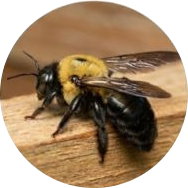
- 13 to 25 mm
- Six legs
- Short antennae
- Robust, black-and-yellow
- Strong fliers
- Bore into wood
1. Are carpenter bees aggressive?
Carpenter bees are not aggressive and rarely sting humans. Male carpenter bees may hover or buzz near people but cannot sting. Females have a stinger but usually only use it if handled or threatened. Unlike honeybees, carpenter bees do not defend hives and prefer to avoid contact.
2. What kills carpenter bees instantly?
Carpenter bees can be killed quickly with direct-contact insecticides designed for bees or wasps. These products work only when applied directly to the insect. However, killing individual bees does not solve the problem long term. Treating nests and repairing wood is necessary to prevent repeat activity.
3. Are carpenter bees dangerous?
Carpenter bees are not considered dangerous to people. Male bees cannot sting, and females rarely sting unless provoked. The main risk is property damage, not injury. Over time, their tunneling can weaken wooden structures and attract woodpeckers, which can cause even more damage.
4. What do carpenter bees eat?
Carpenter bees eat flower nectar and pollen, not wood. Adults feed on nectar for energy and collect pollen to feed their larvae. The wood they drill is only used for nesting tunnels. They visit many flowering plants and play an important role as pollinators in gardens.
5. Do carpenter bees make honey?
Carpenter bees do not make honey. They are solitary insects and do not live in colonies or hives. Instead of storing honey, female carpenter bees create individual nesting tunnels in wood and place pollen and nectar inside to feed their developing larvae.
6. How to make a carpenter bee trap?
A carpenter bee trap is made from a small untreated wood block with angled entry holes drilled into the sides and a collection jar attached underneath. The holes mimic natural nesting tunnels, causing bees to enter and drop into the jar, where they cannot escape. Traps work best when hung near active wood.
7. How to keep carpenter bees away?
Carpenter bees can be kept away by sealing and painting exposed wood, especially decks and eaves. They avoid painted or stained surfaces. Filling old holes, using citrus or almond oil sprays, and placing traps early in spring also helps prevent nesting before damage begins.
8. How to get rid of carpenter bees naturally?
Natural carpenter bee control includes spraying nesting holes with citrus, almond, or peppermint oil, which repels them. Hanging wooden traps, sealing old tunnels, and painting bare wood are effective long-term steps. These methods discourage nesting without harsh chemicals and work best when applied consistently.
9. Are carpenter bee stings dangerous?
Carpenter bee stings are rarely dangerous. Only females can sting, and they usually do so only if handled or threatened. Most stings cause mild pain and swelling. Serious reactions are uncommon but possible in people with bee sting allergies, who should seek medical care immediately.
10. Are carpenter bees bad?
Carpenter bees are not bad insects, but they can be a problem for homes. They are beneficial pollinators, yet their nesting behavior damages exposed wood over time. While they pose little risk to people, unmanaged carpenter bee activity can weaken decks, siding, and other wooden structures.
11. What eats carpenter bees?
Carpenter bees are eaten by several natural predators. Woodpeckers are the most common, drilling into wood to reach larvae. Other predators include insect-eating birds, robber flies, mantises, and parasitic flies like the tiger bee fly, which lays eggs inside carpenter bee nests.
12. How do carpenter bees drill holes?
Female carpenter bees drill holes using strong mandibles that chew through wood fibers. They create a perfectly round entrance, then tunnel along the wood grain to form nesting chambers. The bees do not eat the wood; they push out sawdust while building tunnels for eggs.
13. Why do carpenter bees hover?
Carpenter bees hover mainly for territorial defense and mating. Male bees patrol nesting areas and hover near people or animals to scare them away. This behavior looks aggressive, but males cannot sting. Hovering also helps them locate females and protect nesting sites in spring.
14. How do carpenter bee traps work?
Carpenter bee traps work by mimicking natural nesting holes in wood. Bees enter angled holes, fall into a collection chamber, and cannot escape. Trapped bees release scents that attract others. Traps reduce activity but work best when combined with sealing holes and wood protection.
15. When do carpenter bees come out?
Carpenter bees usually emerge in early spring when temperatures reach the low 60s°F. This often happens between March and May. Adults are most active during spring mating season and again in late summer when new bees emerge before overwintering in nesting tunnels.
16. What are carpenter bees good for?
Carpenter bees are valuable pollinators, especially for plants that require buzz pollination. They help pollinate tomatoes, blueberries, eggplants, and many wildflowers. While they can damage wood, they play an important role in supporting ecosystems and local plant reproduction.
Share