
What Smells Do Rats Hate?

Written by Jack Hayes
Last updated on October 16, 2026

What smells do rats hate? Rats may react to sharp, unfamiliar odors such as peppermint or vinegar, but no household scent reliably drives an established rat problem out of a home. Strong smells may make one area less appealing for a short time, then rats can return after the odor fades.
That matters if you hear scratching in the attic, find droppings, or notice new gnaw marks. In this guide, we’ll explain which smells rats may avoid, what scent-based tricks can and cannot do, and what works better for long-term rat control.
Key Takeaways
◉ Strong smells like peppermint and vinegar may make rats avoid an area for a short time, but they do not remove an active infestation.
◉ Rats can change their travel routes once a scent becomes unpleasant, then return after the smell fades.
◉ Peppermint oil is not a reliable long-term rat control method, especially if food, water, shelter, or entry points remain.
◉ Fresh droppings, gnaw marks, scratching sounds, and disturbed food are better signs of active rats than changes in smell.
◉ Long-term rat control works best when homeowners remove attractants, seal entry points, place traps correctly, and get professional help if activity continues.
What Smells Do Rats Hate?
Rats can be cautious around strong or unfamiliar odors. Peppermint, vinegar, ammonia, and strongly scented plant oils are often suggested as rat repellents. NC State Extension reported in 2024 that these types of odor repellents have been tried, but they are not considered reliable methods for managing rat problems.
A scent may change a rat’s behavior for a short time without removing the rat. The animal may avoid one corner, use another route, or return after the smell weakens.
◉ Peppermint may make a treated spot less attractive temporarily.
◉ Vinegar has a sharp odor, but it does not create a lasting barrier.
◉ Strong chemical fumes should not be used as homemade rat treatments.
◉ Food, water, shelter, and safe nesting areas can outweigh an unpleasant smell.
Rats that already have reliable food and shelter have strong reasons to stay. Our guide to what rodents eat explains which food sources can keep rodents returning to a property.
What Smell Do Rats Hate the Most?
There is no proven household smell that rats hate enough to make them permanently leave a home. Peppermint gets much of the attention, yet the results are usually temporary. Vinegar and other sharp odors can affect how a rat moves through an area, but the effect can weaken as the odor fades.
For homeowners, it is more useful to focus on what makes the property attractive to rats. Accessible food, water, nesting material, and open entry points give rats reasons to stay. A strong scent cannot close a foundation gap, remove a nest, or catch an active rat. Those physical problems need direct attention.
Does Peppermint Oil Repel Rats?
Peppermint oil may make a small area less attractive to rats for a short period, but it is not dependable rat control. NC State Extension notes that peppermint oil and similar odor repellents lose strength over time and should not replace trapping, sanitation, or exclusion.
Peppermint can create another problem near traps. Strong oils placed beside an active trap route may change how a cautious rat approaches the area. If you use peppermint for its smell, do not treat a quiet night as proof the rats have left. Watch for fresh droppings, gnawing, disturbed food, tracks, or continued sounds instead.
Do Rats Hate the Smell of Vinegar?
Rats may react to the sharp smell of vinegar, but vinegar is not a reliable way to remove rats from a house. The smell can make one small area unpleasant, then fade or become easier for the rat to tolerate.
Spraying vinegar around an attic, garage, or kitchen does not change the conditions that brought rats inside. Food remains accessible. Entry holes remain open. Nesting spots remain available. If activity continues after vinegar is used, focus on locating entry points, cleaning up food sources, and placing traps along active travel routes instead of adding more scent.
Do Rats Avoid Human Scent?
Rats can be cautious around new smells connected with people, but human scent is not a dependable attic deterrent. A rat living inside a home is already exposed to human odors from clothing, furniture, soaps, food, and normal household activity.
The Centers for Disease Control and Prevention (CDC) explained in 2024 that rats can be wary of new objects. This behavior is often called neophobia, or fear of new things. It can affect how quickly rats approach traps. Human hair, worn clothing, or strong personal scents will not block an entry hole or make an established attic nesting area unusable. Check how rats get inside your house if attic activity continues.
What Smells Do Mice and Rats Hate?
Mice and rats may both react to strong or unfamiliar odors, but scent alone rarely removes either rodent from a useful nesting area. Peppermint, vinegar, and other sharp smells may change their movement temporarily. The results can vary based on scent strength, airflow, available food, and how long the rodents have been living there.
For both pests, focus first on the conditions supporting them. Store food in hard containers, remove spilled pet food or bird seed, repair water leaks, and close accessible gaps. Correct trap placement matters too. If rodents are already active indoors, our guide to removing rodents from attics, walls, and homes explains practical next steps.
Can Smells Scare Rats Away?
Smells may cause rats to hesitate or avoid one small area, but they rarely scare rats out of a house for good. Once the odor weakens, the same travel route can become usable again.
The U.S. Environmental Protection Agency (EPA) recommends reducing the conditions that support rodents by removing accessible food and water, limiting shelter, and sealing openings they can use to enter buildings. These steps change the property itself instead of trying to cover one area with a stronger odor.
If fresh droppings, chewing, or nighttime scratching continues, treat those signs as possible ongoing activity. Scent can be a minor temporary measure, but it should not be the main plan for getting rats out.
Why Peppermint Cotton Balls May Stop Working in an Attic
A homeowner in Monmouth County starts hearing scratching above the bedroom ceiling late at night. They place peppermint-scented cotton balls around the attic, hoping the strong smell will push the rat out. For the next two nights, the attic seems quiet, and they assume the problem is over. A few days later, scratching starts again near the opposite side of the attic. Fresh droppings appear beside stored boxes, and a bag of bird seed in the garage has small chew marks. The peppermint smell is much weaker now. The rat has not left the home. It has likely changed its route and found another spot away from the strongest scent.
At this point, a professional pest inspection can look beyond the odor. A technician may find a small roofline gap, signs of travel along attic insulation, and food that is easy for the rat to reach. The control plan could include sealing the entry point, securing the bird seed, and placing traps along active travel paths.

After the entry point is closed and the active rat is removed, the homeowner can keep checking for fresh droppings, noises, or new gnaw marks. If those signs stop during follow-up checks, that gives a much clearer picture than peppermint alone. Strong smells may shift rat activity for a short time. Finding the entry point and removing the source is what addresses the real problem.
What a Rat Customer Shared About Having a Clear Plan
One homeowner dealing with an ongoing rat issue contacted Agile Pest Control and was pleased with the quick response and follow-up. They shared that the team explained the next steps clearly and gave them a plan for handling the problem.
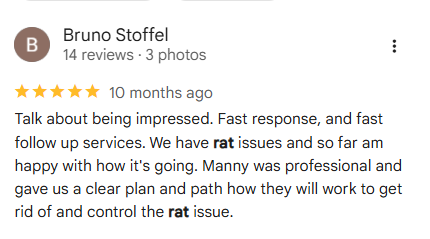
The homeowner said they were happy with how the service was going and appreciated the professional support.
Tried Peppermint and Still Hearing Rats? Here’s What to Do Next
If fresh droppings, gnaw marks, or scratching keep returning, peppermint, vinegar, or another strong scent probably will not solve the problem. The next step is finding where rats enter, what attracts them, and which routes they use inside the home.

Agile Pest Control can help Monmouth County homeowners inspect rat activity, identify possible access points, and choose practical control methods for the property. Professional help can make sense when activity is inside walls or attics, entry points are hard to reach, or home methods have not stopped fresh signs. The goal is to stop the source of the problem rather than cover it with a stronger smell.
Frequently Asked Questions
Will bleach smell keep rats away?
A strong bleach odor may make a small area unpleasant temporarily, but it is not reliable rat control. Use disinfectants for proper cleaning rather than trying to repel rats.
Do rats get used to repellent smells?
Rats may return once an odor weakens or proves harmless. Fresh droppings, gnaw marks, scratching, or disturbed food can show that rodent activity is still present.
Can peppermint oil near a trap make the trap less effective?
Strong oils may change how cautious rats approach a trap area. Keep extra scents away from active travel routes and place traps where you see fresh signs.
How can I tell if rats are still active after using a scent?
Check for fresh droppings, new gnaw marks, scratching sounds, disturbed food, tracks, or trap activity. New signs can point to continued rat activity indoors.
What should I do if rats return after the smell fades?
Look for entry holes, remove accessible food and water, place traps along active routes, and get professional help if fresh signs continue after your control steps.
Share