
Why Wasps Build Nests Around Brick Township Homes in Summer

Written by Jack Hayes
Last updated on September 28, 2026
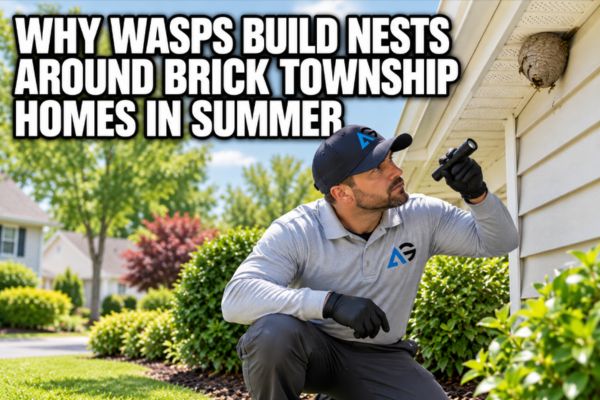
Wasps build nests around homes because sheltered parts of a structure can give a founding queen protection, a stable place to attach a nest, and access to nearby food and building material. The nest usually starts small in spring. By summer, more workers are active, so a colony that was easy to miss earlier can suddenly become obvious around an eave, shed, wall gap, deck, or lawn. The key is not just spotting wasps, but noticing where they repeatedly enter and how close that activity is to people.
Key Takeaways
◉ Wasp colonies usually begin with a queen in spring and become easier to notice as worker numbers grow through summer.
◉ Paper wasps often build exposed nests under sheltered surfaces, while yellowjackets may nest in the ground or hidden structural voids.
◉ A repeated flight path into one gap or ground opening is a stronger nest clue than a few wasps visiting flowers or food.
◉ Nests near doors, walkways, play areas, or other frequently used spaces deserve more caution than nests in low-traffic locations.
◉ Prevention works best before a nest is established: reduce food attractants, inspect sheltered areas, and seal suitable gaps only when no active nest is present.
What Makes a Home Attractive to Nesting Wasps?
Social wasps look for conditions that help a colony get started and remain protected.
- ◉ Shelter: Eaves, soffits, porch ceilings, deck undersides, sheds, garages, and wall cavities can protect nests from weather and disturbance.
- ◉ Nest material: Paper wasps, yellowjackets, and related social wasps make papery nest material from plant or wood fibers mixed with saliva.
- ◉ Food nearby: Many wasps hunt other insects for their young. Adults may also visit ripe fruit, sweet drinks, food spills, and trash.
- ◉ Limited disturbance: A quiet shed corner, roofline, or seldom-used space can allow a small spring nest to grow unnoticed.
Rutgers Cooperative Extension notes that hornets, yellowjackets, and paper wasps are beneficial predators of other insects, even though they can sting when nests are disturbed. Its New Jersey wasp guidance also explains how nest type and location differ among these groups.
For repeated stinging-insect activity, Agile Pest Control’s Brick, NJ pest control page explains local service options.
Why Summer Is When Nests Become Easier to Notice
A social wasp colony begins small. A mated queen survives the cold season, starts a new nest when conditions warm, lays the first eggs, and initially handles much of the building and foraging. Once workers mature, they take over tasks such as gathering food and expanding the nest.
That growth is why summer activity can seem sudden. The nest may have been present for weeks before enough workers were flying to make it noticeable. Later, yellowjackets may become more visible around outdoor food, drinks, trash, and fallen fruit.
A few wasps passing through the yard do not necessarily mean a nest is nearby. Repeated traffic to one exact opening is much stronger evidence.
Where to Look Without Disturbing a Nest
Observe from a safe distance and look for repeated flight patterns.
Eaves, Porch Ceilings, Railings, and Decks
Paper wasps commonly attach exposed combs beneath protected surfaces. Their nests look like small open umbrellas or exposed honeycomb rather than a fully enclosed paper ball.

Wall Voids, Attics, and Structural Gaps
Yellowjackets can use enclosed cavities. You may never see the nest itself, only wasps repeatedly entering a gap around siding, soffits, trim, vents, or another opening.
Do not seal an opening while insects are actively using it. If you are checking exterior gaps after activity has ended, Agile’s guide to common pest entry points around Brick Township homes covers rooflines, vents, utility openings, and other areas worth inspecting.
Ground and Aerial Nests
Some yellowjackets nest in the ground, often using existing cavities. A small hole with steady traffic may be the only visible sign. Avoid mowing, digging, or trimming directly around a suspected entrance.
Bald-faced hornets, which are social wasps, build enclosed paper nests above ground in shrubs, trees, or on structures. Observe these nests from a distance.
How to Read the Clues Without Guessing the Species
Exact identification can be difficult, especially when a nest is hidden. Location and nest shape can still guide your next step.
- ◉ Open comb with visible cells under an eave or railing: more consistent with paper wasps.
- ◉ Repeated traffic into a wall gap or ground hole: may indicate yellowjackets or another cavity-nesting wasp.
- ◉ Large enclosed paper nest above ground: more consistent with a hornet-type aerial nest.
- ◉ Wasps only around flowers, food, or trash with no repeated flight path: may simply be foraging.
These clues guide risk assessment, not guaranteed identification. If identification changes the treatment decision, professional confirmation is safer than moving closer.
When Can a Wasp Nest Be Left Alone?
Not every nest needs the same response. A small paper wasp nest high on an unused outbuilding may create less day-to-day risk than a hidden nest beside a front door or a ground entrance near a play area.
Consider the nest location, how often people or pets pass nearby, whether yard work could disturb it, and whether anyone in the household has a history of serious sting reactions.
If a sting causes trouble breathing, chest tightness, widespread hives, or swelling away from the sting site, treat it as a medical emergency and call 911. Poison Control’s sting guidance recommends immediate emergency help for signs of a severe allergic reaction.
What to Do If You Find an Active Nest
- ◉ Keep children, pets, guests, and yard crews away from the area.
- ◉ Avoid striking, knocking down, flooding, plugging, or otherwise disturbing an active nest.
- ◉ Cover outdoor food and drinks, clean spills, remove fallen fruit, and keep trash containers closed.
- ◉ Avoid mowing or trimming around a suspected ground-nest entrance.
- ◉ If a pesticide is considered, use only a product labeled for the target pest and application site, and follow the label exactly. Hidden, elevated, or heavily active nests are better candidates for professional treatment.
How to Make the Property Less Attractive Next Season
Inspect eaves, porch ceilings, deck undersides, sheds, and other sheltered areas from a safe distance during spring and early summer. Keep trash covered and remove food spills or fallen fruit that can attract foraging wasps.
Seal exterior gaps only after confirming they are not being used by an active nest and are not required vents, drainage features, or flood openings. Rutgers notes that hornets, yellowjackets, and paper wasps abandon their nests in fall and do not reuse the old structure.
When to Call a Professional for Wasp Control
Professional help is worth considering when a nest is inside a wall or attic, underground, high on a roofline, close to an entrance or play area, or difficult to identify without approaching it. That also applies when yard work may disturb the colony or someone has a known serious sting allergy.
A professional can identify the insect, locate the nest, and choose an approach that fits the property.
FAQs
Will wasps come back to the same nest next year?
Generally, no. Social wasps such as paper wasps, yellowjackets, and hornets abandon seasonal nests. A new queen may still choose the same protected area later if the site remains suitable.
Should I remove an old, empty wasp nest?
Removal is optional once you are certain the nest is inactive. Old paper nests are not reused by these seasonal colonies and often deteriorate naturally.
Can I seal a hole where wasps are entering a wall?
Not while the opening is actively being used. Sealing an occupied entry point can trap wasps inside the structure or redirect them. Confirm the colony is no longer active before making exclusion repairs.
Share