
Why Stink Bugs Move Into Freehold Homes as Weather Cools

Written by Jack Hayes
Last updated on September 14, 2026
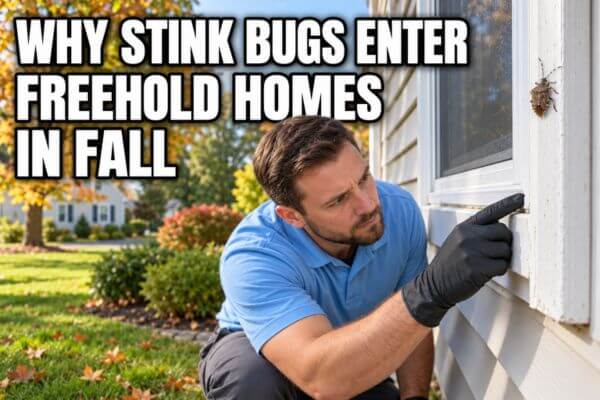
Stink bugs move into homes as fall approaches because they need a protected place to spend the winter. They are not coming indoors to eat pantry food, damage wood, or reproduce. In Freehold, the most useful response is to block entry before adults settle behind siding, trim, or walls. If a few appear indoors later, careful physical removal usually makes more sense than spraying living areas.
Key Takeaways
◉ Brown marmorated stink bugs seek protected overwintering sites in early fall.
◉ They enter through gaps around windows, doors, siding, vents, chimneys, and utility openings.
◉ Adults have a shield-shaped, mottled-brown body with light and dark bands on the antennae and abdomen.
◉ They are nuisance pests indoors and do not reproduce in homes or damage the structure.
◉ Exclusion before the fall movement begins is more useful than trying to reach bugs already hidden in wall voids.
Why Stink Bugs Head Indoors in Fall
The species most associated with fall home invasions is the brown marmorated stink bug, or Halyomorpha halys. Adults spend the growing season outdoors feeding on plants. As summer ends, they begin searching for sheltered places where they can remain inactive through colder weather.
Freehold is within the Mid-Atlantic region, where the U.S. Environmental Protection Agency reports the country’s highest concentrations of brown marmorated stink bugs. That regional context does not predict how many bugs will approach any individual property. Access points and available shelter still shape what happens at a particular home.
A house can provide the same basic protection as a natural crevice. Stink bugs may gather on exterior surfaces and then crawl into small openings around the building envelope. Their destination is often a wall void, attic, or space behind exterior trim rather than a heated room.
This distinction matters. Food cleanup will not solve a stink bug entry problem because the insects are not moving in for crumbs or indoor moisture. The practical target is the route into the structure. Homeowners who also need help with other pest activity can review pest control services for Freehold homes and businesses, while this article remains focused on fall stink bug behavior and prevention.
What Happens After They Get Inside
Once sheltered, adults enter a low-activity overwintering period. Many remain out of sight for weeks or months. Others may emerge from gaps under baseboards, around window or door trim, or near ceiling lights and exhaust fans. A winter sighting does not necessarily mean the bug just entered the house.
They may become noticeable again as conditions warm in spring and overwintering adults try to return outdoors. The bugs are not starting an indoor colony. The same EPA guidance states that they do not reproduce in homes or cause structural damage.
How to Identify a Brown Marmorated Stink Bug
Do not rely on the shield shape alone because several stink bug species share it. An adult brown marmorated stink bug is about 14 to 17 millimeters long and has mottled brown coloring. Look for alternating light and dark bands on the final two antenna segments and along the exposed outer edge of the abdomen.
These markings provide a stronger clue than color by itself. If the insect is damaged, too far away, or lacks a clear banding pattern, a close photograph can help with identification. Avoid assuming that every brown, shield-shaped insect indoors is this species.
Where Stink Bugs Can Enter a Home
Stink bugs use existing openings rather than chewing their way through a building. A careful exterior inspection should include:
◉ Window and exterior-door frames
◉ Worn weatherstripping and gaps beneath doors
◉ Torn screens or loose screen frames
◉ Joints in siding, fascia, and soffits
◉ Attic, roof, dryer, and bathroom vents
◉ Gaps around cables, pipes, and utility boxes
◉ Openings around chimneys and roof penetrations
Inspect upper areas from the ground first. Do not climb onto a roof or use an unstable ladder to reach a gap. A qualified contractor can address openings that are high, difficult to reach, or related to roofing, ventilation, or flashing.

How to Keep Stink Bugs Out Before Cold Weather
Exclusion is most useful before adults have entered hidden spaces. Work through the home systematically instead of applying a quick spray around one window.
◉ Replace damaged screens and confirm that frames fit tightly.
◉ Add or replace weatherstripping where exterior doors do not seal.
◉ Seal suitable cracks around window trim, door frames, siding joints, and utility penetrations with materials made for that surface and location.
◉ Check vent covers, chimney screens, and door sweeps for damage or gaps.
◉ Ask an appropriate professional to repair roofing, soffit, flashing, masonry, or moisture problems rather than covering them with caulk.
Avoid blocking drainage openings or required airflow. Weep holes, appliance exhausts, and attic ventilation serve important functions. If you are unsure whether an opening should be sealed, confirm its purpose first.
What to Do With Stink Bugs Already Indoors
For a few visible bugs, avoid crushing them because disturbance can release their odor. Capture one with a container or remove it with a vacuum. Empty the vacuum bag or canister promptly outdoors because the odor can remain in the machine.
Indoor foggers and broad pesticide applications do not close entry points or reach every insect hidden in walls. The University of Maryland Extension’s indoor-management guidance recommends mechanical exclusion and notes that indoor crack-and-crevice spraying is not a viable way to prevent bugs from emerging into rooms. Any pesticide considered for a specific situation must be labeled for the pest and application site and used exactly as directed.
When Professional Help May Be Useful
Professional help can be reasonable when large numbers keep appearing, the entry route is unclear, or likely access points are too high or complex to inspect safely. An inspection can focus on the building exterior, confirm the pest, and identify practical exclusion priorities.
Treatment decisions vary with the structure, timing, product label, and location of the insects. Once stink bugs are dispersed inside wall voids or attics, a pesticide application is not a substitute for correcting accessible entry points. Plan exclusion before the next fall movement if the problem repeats.
Frequently Asked Questions
Do stink bugs lay eggs inside houses?
Brown marmorated stink bugs normally lay eggs outdoors on plant leaves. Adults that enter a house are seeking winter shelter, and they do not establish a reproducing indoor population.
Why do stink bugs appear near windows in winter?
A bug seen near a window may have emerged from a gap around the trim after spending weeks hidden in a wall or other protected space. A winter sighting does not necessarily indicate a new entry.
Will stink bugs leave the house in spring?
Overwintering adults generally become active as conditions warm and attempt to return outdoors. Sealing exterior gaps before the next fall helps reduce the chance that a new group will use the same access points.
Share