
Why Freehold Homes See More Pest Activity After Heavy Rain

Written by Jack Hayes
Last updated on September 14, 2026
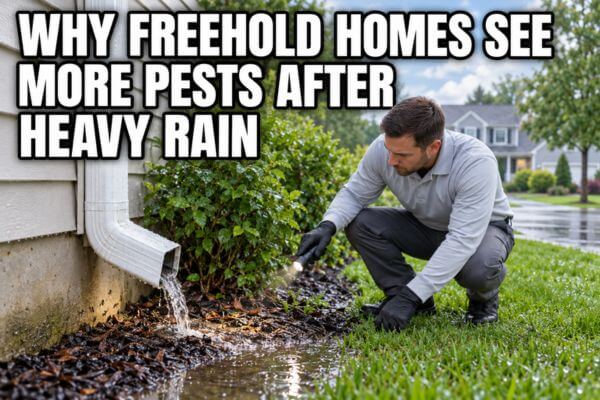
Heavy rain can change pest activity around a home in several ways. Saturated soil and soaked hiding places may displace ants, rodents, and other ground-level pests. Water left in gutters, containers, and low spots can also create mosquito breeding habitat. For Freehold homeowners, a sudden sighting after a storm does not automatically prove there is an infestation. The type of pest, where it appears, and whether the activity continues after the property dries are more useful clues.
Key Takeaways
◉ Heavy rain may displace pests from soil, burrows, mulch, and other outdoor shelter.
◉ Standing water supports mosquito development, so containers and clogged gutters should be checked promptly.
◉ Rain does not create a termite colony, but moisture and spring swarming conditions can make termite signs more noticeable.
◉ One insect after a storm may be a temporary visitor, while repeated trails, droppings, mud tubes, or recurring sightings deserve closer attention.
◉ Drainage, drying, exclusion, and accurate identification are more useful than automatically spraying every pest you see
Why Pest Activity Can Change After a Storm
A storm can affect pests through displacement, new moisture, and easier access to shelter. Waterlogged soil may disturb ants or other organisms living near the surface. Damp mulch, leaf litter, crawl spaces, and foundation edges can remain attractive to moisture-dependent pests after the rain ends. Openings around doors, screens, pipes, vents, and the foundation give them possible routes indoors.
These effects vary by pest and property. A storm may expose a drainage problem or entry gap that has been present for months. If activity keeps returning, pest inspection and control options for Freehold properties can help homeowners understand what a property-specific evaluation may cover.
Pests You May Notice After Heavy Rain
Ants and Other Soil-Nesting Insects
Many ant species nest in soil or beneath landscape materials. When those areas become saturated, workers may change their routes or move toward drier cover. An indoor trail after rain can also reflect an existing entry point and access to food or water, not proof that an entire colony suddenly moved into the house.
Repeated activity from the same crack, wall edge, or window area is more useful evidence than a few scattered ants.
Mosquitoes Around Standing Water
Rain does not drive mosquitoes indoors in the same way it may displace a ground-dwelling pest. The larger issue is water that remains after the storm. Mosquitoes can use water in buckets, plant saucers, toys, tarps, clogged ditches, and temporary puddles.
The Monmouth County Office of Mosquito Control emphasizes source control by reducing or eliminating standing water where larvae develop. Empty removable containers, clear blocked gutters, and correct places that repeatedly hold water. Development speed varies with species and conditions, so prevention should not depend on waiting a fixed number of days.
Termites and Winged Ants
Heavy rain does not cause a new termite infestation overnight. In the Northeast, naturally occurring termites are subterranean termites that nest in soil. Rutgers NJAES reports that their swarmers are commonly seen on warm, sunny days from April through June and seek moist, sheltered places after their flight. Rutgers recommends reducing moisture, maintaining downspouts, avoiding wood-to-soil contact, and keeping cellulose materials away from the house. Rutgers NJAES explains termite biology and prevention in more detail.
Winged termites can be confused with winged ants. Discarded wings, mud tubes, or swarmers indoors should be identified instead of treated as a generic post-rain bug problem. This guide to termite signs in Freehold homes covers the warning signs without expanding this article into a termite-identification guide.
Rodents and Moisture-Dependent Invaders
Flooding can displace rodents, but existing gaps, food, and protected indoor shelter still affect whether they enter a home. Droppings, gnaw marks, nesting material, or repeated noises are stronger indicators than weather alone.
Millipedes, centipedes, and some cockroaches may also become more noticeable around damp basements, garages, crawl spaces, and foundation edges. Their presence can point to excess moisture or an entry gap, but these pests still require accurate identification.
Is It a Temporary Visitor or an Established Problem?
Post-storm timing is useful context, but it is not a diagnosis. Look at the pattern:
◉ Activity that begins after rain and fades as the area dries may reflect temporary movement.
◉ One millipede or other occasional invader near a basement door is different from recurring live activity across several rooms.
◉ Ants returning along the same trail suggest a reliable entry route or nearby nesting activity.
◉ Rodent droppings, gnawing, nesting material, or repeated sounds warrant investigation. Do not identify a rodent from one uncertain mark alone.
◉ Termite mud tubes, discarded wings, or indoor swarmers require accurate identification, even if they appear soon after wet weather.
◉ Cockroaches seen repeatedly, especially in kitchens, bathrooms, or utility areas, can indicate a problem that will not be solved by drying one puddle.
When safe, take a clear photo or save an intact specimen. Note the room, time, and nearby moisture to support identification.
A Practical Post-Storm Pest Check
Once the storm has passed and the property is safe to inspect, walk through these areas:
◉ Check gutters and downspouts for blockages, overflow marks, and discharge beside the foundation.
◉ Empty buckets, toys, plant saucers, tarps, wheelbarrows, and other movable items that collected water.
◉ Look for torn screens, worn door sweeps, and gaps around pipes, cables, vents, or foundation penetrations.
◉ Check basements, crawl spaces, garages, and utility areas for leaks, seepage, condensation, or materials that stayed wet.
◉ Keep mulch and stored firewood from touching siding or covering foundation inspection areas.
◉ Record pest signs before cleaning them up, especially wings, mud tubes, droppings, trails, or the exact point where insects enter.
Do not enter a flooded space or approach wet electrical equipment to complete a pest check. If significant water entered the home, address the water problem before routine pest prevention.

Prevention That Matters Most After Rain
Start with the condition the storm revealed. Move water away from the foundation, repair leaks, dry damp indoor areas, and seal practical entry points. Keep food and trash contained so a displaced pest does not find a second reason to stay.
Avoid treating every post-rain sighting with a broad spray. Pesticide directions differ by product, pest, and application site. If you use a pesticide, follow the label exactly. Moisture control, monitoring, and exclusion often support a longer-term solution.
When a Professional Inspection Makes Sense
Consider an inspection when activity repeats after the property dries, the pest cannot be identified, or signs suggest an established problem. Indoor termite swarmers, mud tubes, recurring cockroaches, rodent evidence, or ants repeatedly emerging from the same structural area deserve more than a quick cleanup.
An inspection can identify the pest, locate entry or nesting areas, and assess whether moisture or structural conditions contribute.
Frequently Asked Questions
Does heavy rain kill pests living outside?
Sometimes rain kills individual pests, but many survive in protected sites or relocate. The result depends on the pest, the severity of flooding, and available shelter. A storm can reduce activity in one place while making it more visible somewhere else.
Should I spray around my house immediately after heavy rain?
Not automatically. First remove standing water, dry damp areas, look for entry points, and identify the pest. If a pesticide is needed, use a product labeled for that pest and location and follow every label direction.
Does seeing pests after rain mean my home is dirty?
No. Weather-related movement, moisture, and entry gaps can affect a well-kept home. Food residue and clutter may help some pests remain, but cleanliness alone does not explain termite swarmers, standing-water mosquitoes, or pests entering through structural openings.
Share