
65 Pest Control Statistics for 2027 (Latest & Updated)

Written by Jack Hayes
Last updated on October 8, 2026
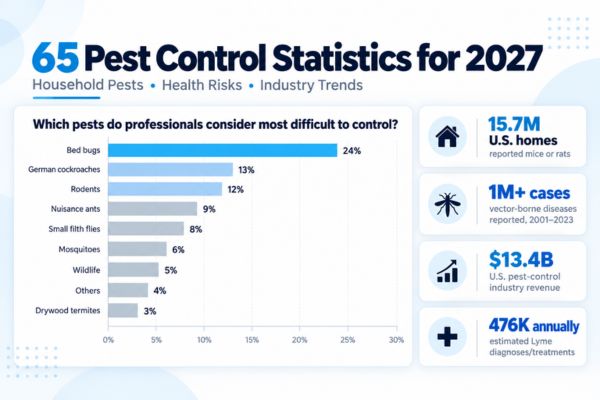
Pests are more than a seasonal nuisance. They affect millions of American homes, can contribute to health and allergy problems, and support a pest-control industry worth billions of dollars each year.
The statistics below look at pest control from several angles, including pests found inside homes, health risks linked to rodents, cockroaches, ticks and mosquitoes, the pests professionals find hardest to manage, seasonal demand, and changes within the pest-control industry.
Where possible, the data comes from government agencies and original research, including the U.S. Census Bureau, Centers for Disease Control and Prevention (CDC), Bureau of Labor Statistics (BLS), New Jersey Department of Health, National Pest Management Association (NPMA), and peer-reviewed studies. Because official datasets are often released with a delay, the year in the title does not necessarily match the year every statistic was collected.
Pest Problems Inside American Homes
Pest problems remain common in American households, although the level of exposure varies by pest, housing conditions, and location. National housing data and recent consumer surveys show that rodents, cockroaches, and ants continue to affect a meaningful share of homes.
1. About 15.7 million occupied U.S. homes reported signs of mice or rats inside during the previous 12 months. The 2023 American Housing Survey represented about 133.2 million occupied housing units, meaning roughly 11.8% of occupied homes reported evidence of rodents.
Source: U.S. Census Bureau — 2023 American Housing Survey
2. Roughly 1 in 8 occupied U.S. homes showed evidence of mice or rats. Based on 15.7 million affected units out of 133.2 million occupied homes, the share works out to approximately 11.8%.
Source: U.S. Census Bureau — American Housing Survey
3. Seventeen percent of Americans said they encountered rodents in their homes during 2025. This suggests that household rodent encounters remain relatively common even when measured through recent consumer surveys.
Source: NPMA / The Harris Poll — 2025 Household Pest Survey
4. Twenty-one percent of Americans said they had seen a cockroach in their home. That means more than one in five respondents reported encountering cockroaches indoors.
Source: NPMA / The Harris Poll
5. Thirty-one percent of Americans said they had dealt with ant problems in their home multiple times. The figure shows that ant problems are often recurring rather than isolated incidents.
Source: NPMA — 2026 Ant Awareness Survey
Rodents and Their Impact on Households
Rodents can create property and sanitation problems, but their public-health importance goes further. Hantavirus is one of the clearest examples: it is rare in the United States, but infections can be severe.
6. CDC recorded 890 U.S. hantavirus disease cases through the end of 2023. Although the overall number is relatively small, hantavirus remains an important rodent-related health concern because of its severity.
Source: CDC — Reported Cases of Hantavirus Disease
7. Of those 890 cases, 859 were classified as hantavirus pulmonary syndrome. This means the large majority of confirmed cases involved the serious pulmonary form of the disease.
Source: CDC Hantavirus Surveillance
8. About 35% of reported U.S. hantavirus infections resulted in death. The high fatality rate helps explain why preventing exposure to infected rodents and their waste is important.
Source: CDC — Hantavirus Case Data
9. Ninety-four percent of reported U.S. hantavirus cases occurred west of the Mississippi River. This shows that the geographic distribution of hantavirus risk is highly uneven across the country.
Source: CDC — Hantavirus Case Data
10. Sixty-two percent of confirmed U.S. hantavirus patients were male. Men therefore represented a clear majority of reported cases in the available CDC data.
Source: CDC — Reported Hantavirus Cases
Cockroaches and Housing Conditions
Cockroaches are especially important in housing and public-health research because their allergens can aggravate asthma. Much of the strongest evidence comes from studies of children living in urban areas, so these figures should not be treated as nationwide infestation rates.
11. Cockroaches were reported in 58% of homes participating in the Inner-City Asthma Study. The figure highlights how common cockroach exposure was within the specific urban households included in the research.
Source: Inner-City Asthma Study — NIH/PMC
12. Sixty-nine percent of children in the Inner-City Asthma Study showed skin-test sensitivity to cockroach allergen. This indicates a high level of allergic sensitivity among the children studied.
Source: Inner-City Asthma Study — PubMed
13. Detectable cockroach allergen was found in 85.3% of bedrooms examined in an earlier multicity inner-city asthma study. The finding shows how widespread measurable cockroach allergen exposure was within that study population.
Source: American Academy of Allergy, Asthma & Immunology Work Group Report
14. High cockroach-allergen levels were found in 50.2% of the bedrooms studied. In other words, about half of the bedrooms contained allergen levels considered high by the researchers.
Source: NIH/PMC — Indoor Pest and Allergen Exposure Research
15. In another major inner-city asthma study, 36.8% of children were allergic to cockroach allergen. This provides additional evidence of the relationship between cockroach exposure and allergic sensitivity among children with asthma.
Source: New England Journal of Medicine study via PubMed
Ticks, Lyme Disease and Where Risk Is Highest
Lyme disease is the most commonly reported vector-borne disease in the United States. CDC uses several systems to measure its burden, which is why surveillance totals and estimates based on medical records can differ substantially.
16. More than 80,000 Lyme disease cases were reported to CDC in 2023. The figure reflects cases recorded through public-health surveillance rather than the total number of people who may have been diagnosed or treated.
Source: CDC — Lyme Disease Surveillance and Data
17. CDC estimates that approximately 476,000 people may be diagnosed and treated for Lyme disease each year. This estimate is much higher than the number of cases reported through routine surveillance.
Source: CDC — Lyme Disease Data
18. Around 90% of U.S. Lyme disease cases have been reported from 15 high-incidence jurisdictions. This shows how concentrated Lyme disease risk is in particular parts of the country.
Source: CDC MMWR — Lyme Disease Surveillance
19. CDC received reports of 62,551 Lyme disease cases in 2022. That represented a major increase compared with the average number reported during the years immediately before the surveillance definition changed.
Source: CDC MMWR — Revised Lyme Disease Case Definition
20. The 2022 Lyme disease case count was approximately 68.5% above the 2017–2019 annual average. However, this increase needs to be interpreted carefully because changes in CDC surveillance definitions affected how cases were counted.
Source: CDC — Surveillance After the Revised Lyme Case Definition
Mosquitoes and the Spread of West Nile Virus
West Nile virus is the leading domestically acquired mosquito-borne viral disease in the continental United States. CDC tracks cases through ArboNET, providing detailed information on severe illness, hospitalizations, deaths, and geographic spread.
21. The United States reported 1,808 West Nile virus disease cases in 2024. The figure shows that West Nile remains an ongoing mosquito-borne health concern.
Source: CDC MMWR — West Nile Virus and Other Arboviral Diseases, 2024
22. Seventy-five percent of reported West Nile cases were neuroinvasive. These are the more serious cases in which the virus affects the nervous system.
Source: CDC — 2024 West Nile Disease Data
23. Seventy-seven percent of reported West Nile patients were hospitalized in 2024. The high hospitalization rate reflects the seriousness of many reported cases.
Source: CDC MMWR — West Nile Virus 2024
24. There were 173 deaths among reported West Nile disease cases in 2024. This demonstrates that West Nile can lead to severe and sometimes fatal illness.
Source: CDC — West Nile Surveillance 2024
25. West Nile disease was reported from 591 U.S. counties in 2024. The broad geographic spread shows that the disease was not limited to only a small number of locations.
Source: CDC MMWR — Geographic Distribution of West Nile Virus
Bed Bugs and the Challenge of Controlling Them
Bed bugs are difficult not only to eliminate but also to identify correctly. Recent NPMA research includes both a consumer survey and a separate survey of pest-control professionals, providing perspectives from homeowners and the industry.
26. Only 29% of Americans correctly identified bed bugs. This suggests that many people may struggle to recognize an infestation accurately.
Source: NPMA / Harris Poll — 2025 Bed Bug Survey
27. Only 28% of Americans said they inspect hotel rooms for bed bugs before staying overnight. The figure suggests that routine bed-bug precautions are not widely practiced by travelers.
Source: NPMA — 2025 Bed Bug Facts
28. Forty-four percent of Americans said they would leave their accommodation if they discovered bed bugs. Fewer than half of respondents said they would immediately leave after finding an infestation.
Source: NPMA / Harris Poll Bed Bug Research
29. More than 82% of surveyed pest-control professionals had treated bed bugs during the previous year. This indicates that bed bugs remain a common issue for professional pest-management companies.
Source: NPMA / University of Florida Pest Professional Survey
30. Eighty-nine percent of professionals who treated bed bugs reported treating them in single-family homes. This shows that bed bugs are not limited to hotels, apartments, or other shared accommodations.
Source: NPMA / University of Florida Bed Bug Survey
The Pests Professionals Find Hardest to Manage
Consumer surveys tell us which pests people encounter, while professional surveys provide another perspective: which pests are commonly misidentified and which are particularly difficult to eliminate.
31. Ninety percent of surveyed pest-control professionals said customers often call about suspected bed bugs that turn out to be another pest. This makes incorrect identification a common problem in bed-bug complaints.
Source: NPMA — Bugs Without Borders
32. Carpet beetles were involved in 60% of the bed-bug false alarms reported by pest professionals. They were one of the most common pests mistaken for bed bugs.
Source: NPMA — Bugs Without Borders Survey
33. Flies were reported in 48% of bed-bug misidentification cases. This further shows how easily homeowners can mistake other household pests for bed bugs.
Source: NPMA / University of Florida Professional Research
34. Cockroaches accounted for 32% of pests mistaken for bed bugs by customers. Correct identification is therefore important before deciding on a treatment approach.
Source: NPMA — Bugs Without Borders
35. Twenty-four percent of pest professionals ranked bed bugs as the single hardest pest to control. This suggests that treatment difficulty remains one of the biggest challenges associated with bed-bug infestations.
Source: NPMA — 2025 Bugs Without Borders Research
Seasonal Changes in Pest Activity and Demand
There is no single national dataset measuring every household pest month by month. However, public-health surveillance and pest-industry employment data show clear seasonal patterns in both pest-related risks and professional service demand.
36. Eighty-four percent of reported West Nile disease cases in 2024 began between July and September. This shows how strongly West Nile risk is concentrated during the warmer months.
Source: CDC — West Nile Virus Seasonality, 2024
37. Pest-control industry employment reached about 155,200 workers in April 2025. This provides a useful starting point for looking at seasonal changes in industry staffing.
Source: Bureau of Labor Statistics — Exterminating and Pest Control Services
38. Employment increased to approximately 159,500 in May 2025. The rise suggests that pest-control companies were expanding their workforce as demand increased.
Source: BLS Current Employment Statistics
39. Pest-control employment reached approximately 160,600 in June 2025. Employment continued to climb as the industry moved further into the warmer season.
Source: U.S. Bureau of Labor Statistics — NAICS 56171
40. Employment was approximately 160,900 in July 2025. Compared with April, this reflects a noticeable seasonal increase in pest-control staffing.
Source: BLS — Pest Control Industry Employment
The Health Risks Linked to Common Household Pests
The health burden associated with pests varies considerably. Cockroaches may worsen allergic disease, while ticks and mosquitoes can transmit pathogens capable of causing serious or fatal illness.
41. More than 1 million vector-borne disease cases were reported in the United States between 2001 and 2023. CDC includes diseases spread by ticks, mosquitoes, and fleas within this total.
Source: CDC — About Vector-Borne Diseases
42. Annual reported U.S. vector-borne disease cases more than doubled between 2001 and 2023. The long-term increase highlights the growing public-health importance of diseases transmitted by mosquitoes, ticks, and fleas.
Source: CDC — National Vector-Borne Disease Strategy
43. The case-fatality rate among reported neuroinvasive West Nile patients was 13% in 2024. This applies to the more serious neurological form of the disease, not to all West Nile infections.
Source: CDC MMWR — West Nile Virus Disease, 2024
44. West Nile neuroinvasive disease incidence reached 1.30 cases per 100,000 among adults age 70 and older in 2024. The figure shows that serious West Nile illness affects older adults at a much higher rate.
Source: CDC — Age-Specific West Nile Incidence
45. Children who were both allergic to cockroach allergen and highly exposed averaged 0.37 asthma hospitalizations per year in one major study. The finding illustrates how allergen exposure can contribute to more serious asthma outcomes among vulnerable children.
Source: New England Journal of Medicine — Cockroach Allergen and Childhood Asthma
The Size and Growth of the Pest Control Industry
Pest control is also a substantial service industry. The latest structural pest-control analysis from Specialty Consultants, summarized by NPMA, surveyed 800 pest-control company owners and managers.
46. The U.S. structural pest-control industry generated an estimated $13.416 billion in service revenue in 2025. This shows the significant economic scale of professional pest management in the United States.
Source: NPMA / Specialty Consultants — 2025 U.S. Structural Pest Control Industry Study
47. Industry revenue increased 6% in 2025. The growth suggests that demand for professional pest-control services continued to expand.
Source: NPMA — U.S. Pest Control Industry Growth Report
48. U.S. structural pest-control revenue was estimated at $12.654 billion in 2024. Comparing this figure with 2025 shows how much the industry grew in a single year.
Source: NPMA / Specialty Consultants Industry Analysis
49. Nearly 13.29 million residential customers received professional pest-control services in 2025. This illustrates the size of the industry’s residential customer base.
Source: NPMA — 2025 Structural Pest Control Industry Study
50. Recurring service accounted for 85.4% of residential pest-control service revenue in 2025. The figure shows how important ongoing service agreements are to the residential pest-control business model.
Source: NPMA / Specialty Consultants
Pest Control Businesses, Workers and Wages
The industry’s growth depends on thousands of pest-control companies and a specialized workforce. Industry surveys and federal labor data may produce slightly different totals because they use different definitions and methodologies.
51. An estimated 16,565 pest-control firms operated across the United States in 2025. This shows that the industry includes a large number of companies serving residential and commercial customers.
Source: NPMA — U.S. Pest Control Industry Study
52. More than 81.4% of pest-control firms operated only one or two locations. The figure suggests that smaller and locally focused businesses make up a large share of the industry.
Source: NPMA / Specialty Consultants 2025 Study
53. The industry employed an estimated 109,384 service technicians in 2025. These workers form the core field workforce responsible for inspecting and treating pest problems.
Source: NPMA — Pest Control Technician Employment Estimate
54. The median annual wage for U.S. pest-control workers was $45,250 in May 2025. This provides a useful benchmark for earnings within the occupation.
Source: U.S. Bureau of Labor Statistics — Pest Control Workers
55. About 13,700 pest-control worker openings are projected each year from 2025 through 2035. Many of these openings are expected to come from both industry growth and the need to replace workers who leave the occupation.
Source: BLS Occupational Outlook Handbook
Pest Trends and Risks in New Jersey
Because Agile Pest Control serves New Jersey, state-level data provides especially useful local context. New Jersey’s public-health agencies maintain detailed surveillance for tick-borne and mosquito-borne diseases.
56. New Jersey reported 21,284 tick-borne disease cases between 2022 and 2024. The total highlights the significant burden of tick-related illness within the state.
Source: New Jersey Department of Health — Tick Surveillance Recommendations
57. New Jersey also recorded 1,039 reported cases of Alpha-Gal Syndrome between 2022 and 2024. This adds another example of the health effects associated with tick exposure in the state.
Source: NJDOH — Tick Surveillance Data
58. New Jersey reported 41 human West Nile virus cases in 2024. The figure shows that mosquito-borne illness remains a meaningful public-health issue in the state.
Source: NJDOH — 2024 Vector-Borne Disease Summary
59. Eight New Jersey residents died from West Nile virus in 2024, while 31 reported cases, or 76%, were classified as neuroinvasive disease. This indicates that a large share of reported cases involved the more serious form of the illness.
Source: New Jersey Department of Health — West Nile Virus 2024
60. By October 2, 2026, West Nile virus had been detected in 1,182 mosquito pools across all 21 New Jersey counties. The statewide detections show how widely the virus was circulating in mosquito populations during the season.
Source: New Jersey Department of Health — October 2026 West Nile Update
What the Data Shows About Changes Over Time
Looking at one year alone tells only part of the story. Longer-term comparisons show an industry that continues to grow alongside changes in employment and a rising reported burden from several vector-borne diseases.
61. Pest-control industry revenue increased by approximately $762 million between 2024 and 2025. Revenue rose from $12.654 billion to $13.416 billion during that period.
Source: NPMA / Specialty Consultants — 2025 Industry Analysis
62. Recurring residential revenue increased from 85.2% of residential service revenue in 2024 to 85.4% in 2025. Although the increase was small, recurring services continued to represent the overwhelming majority of residential pest-control revenue.
Source: NPMA — U.S. Structural Pest Control Industry Study
63. Commercial pest-control service revenue grew by nearly 7% in 2025. This shows that growth was not limited to residential services.
Source: NPMA / Specialty Consultants
64. BLS expects pest-control employment to increase by about 6,000 jobs between 2025 and 2035. The projection suggests continued demand for trained pest-control workers over the next decade.
Source: Bureau of Labor Statistics — Employment Projections
65. Annual reported cases of vector-borne diseases in the U.S. more than doubled between 2001 and 2023. More than 1 million mosquito-, tick-, and flea-borne disease cases were reported during that period, showing the scale of the longer-term public-health challenge.
Source: Centers for Disease Control and Prevention — Vector-Borne Diseases
What These Pest Control Statistics Tell Us
These statistics show why pest control cannot be understood through a single infestation figure or market-size estimate. Household exposure, public-health risks, professional treatment demand, and industry growth all tell different parts of the story.
Millions of American homes report evidence of pests such as rodents, while consumer research continues to show frequent encounters with cockroaches and ants. At the same time, ticks and mosquitoes create a different type of concern, with more than 1 million reported vector-borne disease cases between 2001 and 2023.
The professional pest-control industry has continued to grow alongside these challenges. U.S. structural pest-control revenue reached an estimated $13.416 billion in 2025, while nearly 13.29 million residential customers received professional services.
The data also shows why context matters. A consumer survey about seeing a cockroach measures something different from Census housing data, laboratory testing for allergens, CDC disease surveillance, or an industry revenue estimate. Looking at the source, year, population, and measurement behind each statistic makes the overall picture clearer and more reliable.
For that reason, this resource prioritizes government datasets, original surveys, peer-reviewed studies, and clearly documented industry research wherever possible.
Share