
How to Kill Mosquito Larvae & Eggs?

Written by Jack Hayes
Last updated on July 24, 2026
On this page
You’ve spotted tiny wrigglers or dark specks in standing water, and you may be wondering: how do you kill mosquito larvae and eggs before they become biting adults?
Mosquitoes can breed in buckets, birdbaths, rain barrels, plant trays, clogged gutters, pools, and pet bowls. Eggs often cling to damp surfaces, and larvae move just below the water’s surface. This guide explains how to kill mosquito larvae and eggs, which treatments work in different water sources, and how to stop mosquitoes from breeding around your home.
Key Takeaways
◉ Remove standing water first. Empty buckets, plant trays, toys, and other containers before larvae can grow into adult mosquitoes.
◉ Scrub the waterline. Mosquito eggs may stay attached to container walls after the water is poured out.
◉ Use Bti for water that must remain. Choose a labeled product for ponds, rain barrels, or other permanent water sources.
◉ Clean pet bowls and plant water often. Fresh water and regular washing stop eggs and larvae from developing.
◉ Check hidden breeding spots each week. Gutters, pool covers, drains, tarps, and shaded containers can hold enough water for mosquitoes to breed.
What Do Mosquito Larvae and Eggs Look Like?
Mosquito larvae look like tiny, thin worms that wriggle near the water’s surface. They are often dark brown, gray, or almost black, with a small head and a narrow body. In water, they may hang downward from the surface, then quickly twist away when the container is disturbed.
Mosquito eggs are much smaller. Some species lay single eggs, and others lay grouped egg rafts that resemble tiny dark specks floating on water. Eggs may sit on damp container walls just above the waterline, where they can be hard to notice.
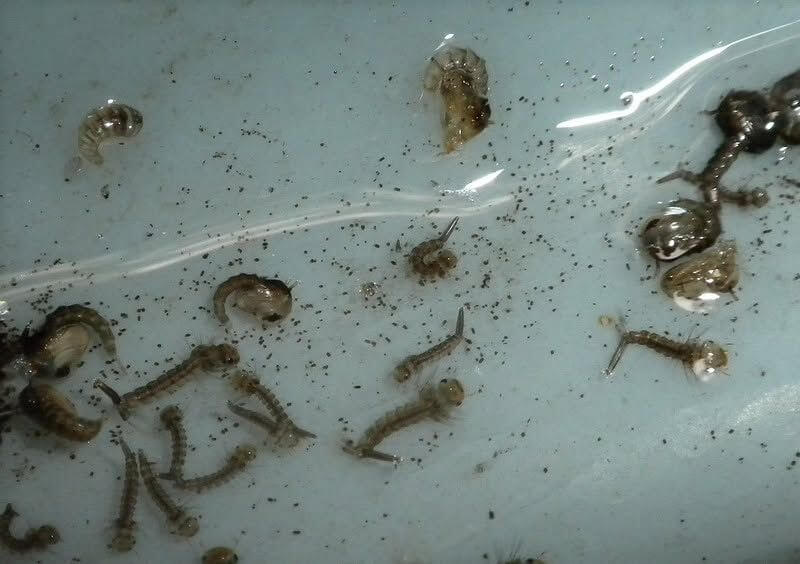
You can see mosquito eggs with the naked eye, but they are easy to miss. Check buckets, birdbaths, plant trays, gutters, and other water-holding items for small floating clusters, dark specks, or moving larvae.
What Are the Red Larvae in Water?
Red larvae in water are often midge larvae, sometimes called bloodworms, rather than mosquito larvae. Their red color comes from a substance that helps them survive in water with low oxygen. Mosquito larvae are usually gray, brown, or dark in color and often stay near the surface. Red larvae tend to live near mud, debris, or the bottom of the container.
Where Do Mosquitoes Lay Their Eggs?
Mosquitoes lay their eggs in or near quiet water where young larvae can feed and grow. Common breeding spots include buckets, birdbaths, clogged gutters, tires, plant saucers, uncovered rain barrels, pool covers, and outdoor toys that collect rain.
Some species place eggs directly on the water in small floating groups. Others attach single eggs to damp surfaces just above the waterline. Those eggs may hatch once the water rises again.
Stagnant water with leaves, algae, or other organic matter gives larvae plenty of food. A container holding water for several days can produce mosquitoes, even when the water looks clean. Check your yard each week and empty any item holding water. Scrub the sides to remove eggs stuck above the waterline.
Why Mosquito Larvae Keep Returning After You Empty the Water
A homeowner notices tiny wrigglers in a bucket near the back door. They pour out the water, rinse the bucket, and leave it upside down.
A few days later, the larvae are back in a nearby plant tray.
They empty that too. Then they check the birdbath and pet bowl. Everything looks clean, but mosquitoes are still gathering around the patio each evening.
That is when they call us.
During the inspection, we find the source above them. A clogged gutter is holding a small amount of rainwater behind wet leaves. The water is hard to see from the ground, but it has been sitting long enough for mosquitoes to lay eggs and for larvae to grow.

We clear the gutter, remove the wet debris, and show the homeowner how to check the plant trays and other containers each week. We also scrub the waterlines, since pouring out water alone can leave mosquito eggs stuck to the sides.
After the hidden water is removed, the larvae stop returning.
That is why mosquito breeding can continue even after you clean the container where you first found larvae. The visible water may only be one source. A clogged gutter, pool cover, toy, or shaded container nearby can keep restarting the problem.
Can Mosquitoes Lay Eggs Inside Your House?
Yes, mosquitoes can lay eggs inside your house when they find still water and a quiet area. Possible sites include plant saucers, flower vases, leaking drain pans, open containers, unused toilets, and standing water near floor drains.
Dark specks on a damp wall near water may be eggs, dirt, or another insect. Clean the surface and remove the nearby moisture source.
How to Kill Mosquito Eggs
The best way to kill mosquito eggs is to remove the water and scrub the container thoroughly. Pouring out the water alone may leave eggs attached to the sides, especially just above the old waterline.
Use a stiff brush with soap and warm water to scrub buckets, birdbaths, plant trays, pet bowls, and similar containers. Rinse them well, then let them dry fully in direct sunlight when possible.
For items that cannot be emptied, use a mosquito control product labeled for that water source. Products containing Bacillus thuringiensis israelensis, often called Bti, target larvae after the eggs hatch. Bti does not kill dry eggs stuck to a surface. What kills mosquito eggs most reliably? Physical removal, thorough scrubbing, full drying, and regular water changes stop them before they hatch.
Are Mosquito Larvae Dangerous?
Mosquito larvae do not bite people or pets, so direct contact rarely causes the same risk as an adult mosquito bite. Their presence still signals that adult mosquitoes may soon emerge from the water.
Larvae develop through several stages before becoming pupae and then flying adults. Warm weather may speed up this process, giving homeowners little time to act. Removing larvae early helps lower the number of biting mosquitoes around patios, doors, windows, and play areas.
Mosquito larvae in a pool are not usually dangerous by themselves. Their presence often points to low sanitizer levels, poor circulation, or water sitting on a pool cover. Avoid swimming until the pool chemistry and filtration have been checked. Remove the larvae, clean the pool, and restore proper sanitizer levels before regular use.
How to Kill Mosquito Larvae
The best way to kill mosquito larvae depends on where you find them. Dumping the water, scrubbing the container, and letting it dry works well for buckets, toys, plant saucers, and other small items.
For water that must remain, use a larvicide labeled for the site. Bti products are commonly used in rain barrels, ponds, birdbaths, and other standing water. Follow the package directions and confirm that the product suits the container, nearby plants, fish, pets, or wildlife.
You can get rid of mosquito larvae with these steps:
◉ Empty removable water onto dry ground.
◉ Scrub the sides to remove eggs and residue.
◉ Refill only when the container is needed.
◉ Change pet and bird water every few days.
◉ Clear leaves from gutters and drains.
◉ Cover rain barrels with fine mesh.
◉ Treat permanent water with an approved larvicide.
◉ Keep pools filtered, circulated, and properly sanitized.
Avoid pouring random household chemicals into ponds, pet bowls, plant water, or drains. Some products may harm animals, plants, surfaces, or water quality. After treatment, inspect the water again within a few days. New larvae mean adult mosquitoes still have access to the site or another nearby container is holding water.
How to Kill Mosquito Larvae in Water
The safest method depends on the type of water. For small containers, empty the water, scrub the sides, and let the item dry. This removes larvae, food residue, and eggs attached near the waterline.
For water that must stay, use a mosquito larvicide approved for that setting. Products containing Bti can kill mosquito larvae in birdbaths, rain barrels, ponds, and similar sites when the label allows such use.
Do not add random cleaners or chemicals to water used by pets, wildlife, plants, or people. The wrong product may damage the container or create a safety risk. Check the treated water within several days. New movement may mean adult mosquitoes laid fresh eggs or another nearby source remains untreated.
How to Kill Mosquito Larvae in Standing Water
To kill mosquito larvae in standing water, remove the water whenever possible. Scrub the container, rinse it, then leave it dry. For permanent water, use Bti granules, dunks, or another labeled larvicide. Follow the product directions closely. Never add bleach, soap, oil, or salt to ponds, pet bowls, or wildlife water without clear label approval.
Will Dumping the Water Kill Mosquito Larvae?
Yes, dumping water usually kills mosquito larvae once they land on dry ground and lose access to water. Pour it away from drains, puddles, and low spots. Dumping alone may leave eggs stuck inside the container. Scrub the inner walls and waterline, then let the item dry before refilling it.
Does Bleach Kill Mosquito Larvae?
Bleach can kill mosquito larvae in water, but it is not a safe choice for most household water sources. It may harm pets, wildlife, plants, beneficial insects, pool surfaces, septic systems, and nearby soil.
Never add bleach to birdbaths, ponds, rain barrels, plant water, pet bowls, or water that may reach fish. Do not guess how much bleach to use. Concentration, water volume, container material, and intended use all affect the risk. For a swimming pool, maintain the sanitizer level listed for the pool system and test the water with a proper kit. For removable containers, emptying, scrubbing, rinsing, and drying is a safer option. Use bleach only for cleaning an emptied container, then rinse it fully before reuse.
Does Vinegar Kill Mosquito Larvae?
White vinegar may kill some mosquito larvae at a strong concentration, but weak mixtures often fail to remove the full population. A useful amount may change the water’s acidity and harm plants, fish, pets, or other wildlife.
Vinegar is better used for cleaning an empty container after the water has been removed. Scrub the sides and base to loosen eggs, algae, and residue. Rinse the item well, then let it dry. Do not pour vinegar into ponds, aquariums, pet bowls, birdbaths, plant water, or swimming pools. For water that cannot be emptied, choose a labeled larvicide suited to that setting.
Does Dish Soap, Hydrogen Peroxide, or Salt Kill Mosquito Larvae?
A natural way to kill mosquito larvae starts with removing the water source. Empty buckets, plant trays, toys, and other small containers, then scrub the inside walls to remove eggs. For water that must stay, Bti is a practical natural mosquito larvae killer. This bacterium targets mosquito larvae after they eat it. Look for Bti dunks, bits, or granules labeled for the water source.
◉ Change birdbath and pet water every few days.
◉ Clear leaves and algae from containers.
◉ Add movement with a small fountain or aerator.
◉ Cover rain barrels with fine mesh.
◉ Use Bti only as directed on the label.
Avoid oils, soap, and homemade mixtures in water used by animals or plants.

One customer said Agile stood out for listening carefully, communicating clearly, and handling the service with real professionalism. That level of attention can be especially helpful when mosquito larvae keep returning and the breeding source is difficult to find.
How to Kill Mosquito Larvae in a Pond
To kill mosquito larvae in a pond, reduce the still, shallow areas where mosquitoes breed. Add water movement with a fountain, bubbler, or aerator. Mosquitoes prefer calm water, so steady circulation makes the pond less attractive for egg laying.
Remove fallen leaves, algae, and decaying plant matter from the water. This material feeds developing larvae and creates quiet pockets near the edges.
A pond-safe Bti product can target larvae without treating the entire yard. Check the label for pond use and follow the listed dose. Fish such as mosquito fish, minnows, and some goldfish may eat larvae, but local rules and pond conditions matter. Inspect plant pots, rocks, and containers near the pond. A small hidden puddle may produce more mosquitoes than the pond itself.
Do Ducks Eat Mosquito Larvae?
Yes, ducks may eat mosquito larvae, insects, and other small organisms found in pond water. They should not be your main control method.
Ducks may miss larvae hiding near plants and shallow edges. Their waste can add nutrients to the pond, leading to algae growth. Use water movement, debris removal, and a pond-labeled larvicide for steadier control.
How to Kill Mosquito Larvae in a Swimming Pool
Proper pool care kills mosquito larvae and stops new adults from emerging. Run the pump, maintain normal sanitizer levels, and brush the pool walls and steps. Moving, treated water is far less suitable for mosquito breeding.
Skim out visible larvae, leaves, and debris. Test the water and adjust chlorine or other sanitizer levels based on your pool system and product directions. Clean clogged filters and check that return jets create steady circulation.
Mosquito larvae in a swimming pool are not likely to bite, yet their presence shows that the water has stayed untreated or still long enough for mosquitoes to breed. Check pool covers, toys, drains, and nearby containers. Water sitting on top of a cover can become a separate breeding site, even when the pool water is properly treated.
How to Get Rid of Mosquito Larvae in Toilets
Mosquito larvae may appear in a toilet bowl that sits unused for days or weeks. Flush the toilet several times, scrub under the rim, and clean the bowl. Check that the tank fills and drains correctly.
Keep the lid closed in rarely used bathrooms and flush the toilet every few days. Repair leaks, clean nearby drains, and remove standing water from buckets or floor areas.
Tiny worms in a toilet may be drain fly larvae rather than mosquito larvae. Drain fly larvae often live in the slimy buildup inside drains and move along wet surfaces. Mosquito larvae tend to wriggle near the water’s surface. For drain fly larvae, scrub the drain walls with a long brush and use an enzyme drain cleaner according to its label.
How to Kill Mosquito Larvae in Plant Water
Mosquito larvae often appear in propagation jars, lucky bamboo containers, plant saucers, and pots that hold water for several days. Start by pouring out the old water, then rinse the roots and wash the container.
Use a soft brush to remove algae, residue, and eggs stuck near the waterline. Refill the container with fresh water. Repeat this process every three to five days to stop larvae from completing their growth cycle.
◉ Keep plant saucers dry after watering.
◉ Remove dead leaves from jars and pots.
◉ Rinse exposed roots during each water change.
◉ Cover wide container openings with fine mesh where practical.
Do not add bleach, dish soap, salt, oil, or larvicide to plant water without product directions confirming safe use around that plant.
How to Prevent Mosquito Larvae in Pet Water Bowls
Mosquito larvae in a water bowl mean the water sat long enough for eggs to hatch. Empty and refill pet bowls every day, especially during warm weather. A quick refill without cleaning may leave eggs and slime attached to the sides.
Wash the bowl with pet-safe soap and a clean brush. Rinse it fully before adding fresh drinking water. Place outdoor bowls in a shaded spot near the home, where you can check them each day.
◉ Use smaller bowls that are easy to clean.
◉ Remove food crumbs, leaves, and dirt.
◉ Keep spare bowls upside down.
◉ Check automatic water dispensers for hidden buildup.
Never place mosquito dunks, bleach, vinegar, oil, or household cleaners in a dog water bowl. Fresh water and regular cleaning offer the safest prevention.
What Kills Mosquito Larvae in Rain Barrels?
A Bti product labeled for rain barrels can kill mosquito larvae without emptying the full barrel. Bti comes in dunks, bits, and granules. Use the amount listed on the package for your barrel size and intended water use.
Cover every opening with fine insect mesh so adult mosquitoes cannot reach the water. Check the screen for tears, gaps, or loose edges. Keep overflow pipes covered with mesh too.
Remove leaves, algae, and sediment from the barrel on a regular schedule. Organic debris gives mosquito larvae food and may reduce water quality. Do not add bleach, soap, salt, or oil to stored rainwater. These materials may harm plants, soil, pets, or wildlife. Empty and clean the barrel if heavy buildup remains inside.
How to Prevent Mosquito Larvae in Water
Preventing mosquito larvae starts by stopping adult mosquitoes from reaching still water. Walk around your home once a week and check buckets, toys, tarps, gutters, plant trays, birdbaths, pool covers, and drainage areas.
◉ Empty small containers after rain.
◉ Scrub waterlines to remove attached eggs.
◉ Change birdbath water every few days.
◉ Clean pet bowls daily.
◉ Cover rain barrels with fine mesh.
◉ Keep pools filtered and properly treated.
◉ Add movement to ponds with an aerator or fountain.
◉ Use a labeled Bti product in water that cannot be removed.
Pay close attention to shaded corners and items hidden behind sheds or shrubs. A small amount of water can support mosquito growth, so regular checks can greatly reduce the number of biting adults around your home.
Still Finding Mosquito Larvae Around Your Home?
If mosquito larvae keep returning after you empty and clean the water, another breeding spot may be nearby. Check gutters, drains, plant trays, pool covers, rain barrels, toys, and shaded containers. A pest control professional can inspect the property, locate missed breeding sites, and recommend the right treatment for each water source.

Agile Pest Control can help identify where mosquitoes are breeding and reduce the conditions that allow them to return.
Share